

Photo Credit: Armin Kleiner https://commons.wikimedia.org/wiki/File:Florence,_Piazza_SS_Annunziata_with_Ospedale_degli_Innocenti_(1419-39)_and_part_of_SS_Annunziata_(1601).jpg
On a recent trip to Italy, my husband and I visited the Museo degli Innocenti at the Ospedale degli Innocenti, or Hospital of the Innocents, in Florence. Although it is called “hospital”, it was really an orphanage built to house and care for the orphans and abandoned children of Florence. Amazingly, it has been in continuous operation for almost 600 years and still provides temporary housing, services and parenting support to women, infants, and children. They also host educational workshops and creative activities related to art and culture for schools and families. Inside, there are museums that you can visit and which I highly recommend, especially if you have ever discovered a foundling in your family history.

Construction on the orphanage began in the year 1419 and was funded by The Arte della Seta (Guild of Silk Weavers and Merchants). The orphanage was designed by Filippo Brunelleschi, the same Renaissance master who designed the famous dome of the Cathedral of Santa Maria del Fiore. The architecture alone is something to admire but also inside are impressive works of art including frescoes, furniture, panel paintings, manuscripts and more. Although some works of art were sold over the years to provide funding for the hospital, among the pieces still remaining are a painting by Botticelli as well as pieces by Domenico di Michelino, Piero di Cosimo, Andrea della Robbia, Luca della Robbia and others. Domenico Ghirlandaio painted The Adoration of the Magi for the main church inside the hospital. They also have temporary rotating exhibitions. When we were there, we saw the work of Henri de Toulouse-Lautrec and there was an exhibit called “Girls in the Innocenti Archives: 1900-1921”.

In February 1445, the Ospedale took in the first foundling, a baby girl given the name Agata Smeralda. By the year 1484, they housed 600 children, the majority girls, and were taking in 1000 new admissions per year. According to the museum placards, in 1627, the hospital was providing care in one way or another for over 2000 women and children. By 1768, they were supporting over 3000, and “by 1873, shortly before the wheel was shut down, the yearly intake had risen to 2,318.”
Like most orphanages, there was a grated window where babies could be abandoned anonymously. Foundling babies were put into the care of a wet nurse, usually poor local women but sometimes even mothers of the children that had been taken in. Over time, babies were sent to wet nurses in the countryside as well. Babies who survived the high infant mortality rate of the time would also receive an education. Girls were taught to sew, cook and clean while boys were taught reading, writing and skills they could use to earn a living. In the mid-late 1500s, they were also educated in the arts. Girls received a dowry from the hospital if they married or they could become nuns. Starting in 1812, the Ospedale began giving each baby a unique surname but in 1875, the grated window was closed so babies could no longer be left anonymously. Instead, they started a “Delivery Office” to receive the children. Over the years, responsibility for the Ospedale changed hands, but in 1890, it became a Public Charity institution.

For me, the most interesting part of the Historical Archives were the examples of the tokens that were left with foundling babies. Tokens were usually little medals, coins, crosses or charms that were left with the baby when it was placed into the receiving wheel. Sometimes the token was very simple–a button, a piece of ribbon or cord, a piece of rosary, even walnut shells. Often, they were cut in half–one half went with the baby and one half stayed with the parent(s). The purpose was to put some identifying item with the child so that, should the parents be able to claim the child in the future, they would be able to describe the token, or provide the second half of the token, to prove parentage. One of the placards said that “In 1861 as many as 1,477 tokens were left with more than half of the boys and girls who were probably legitimate children who could be taken back by their families.”
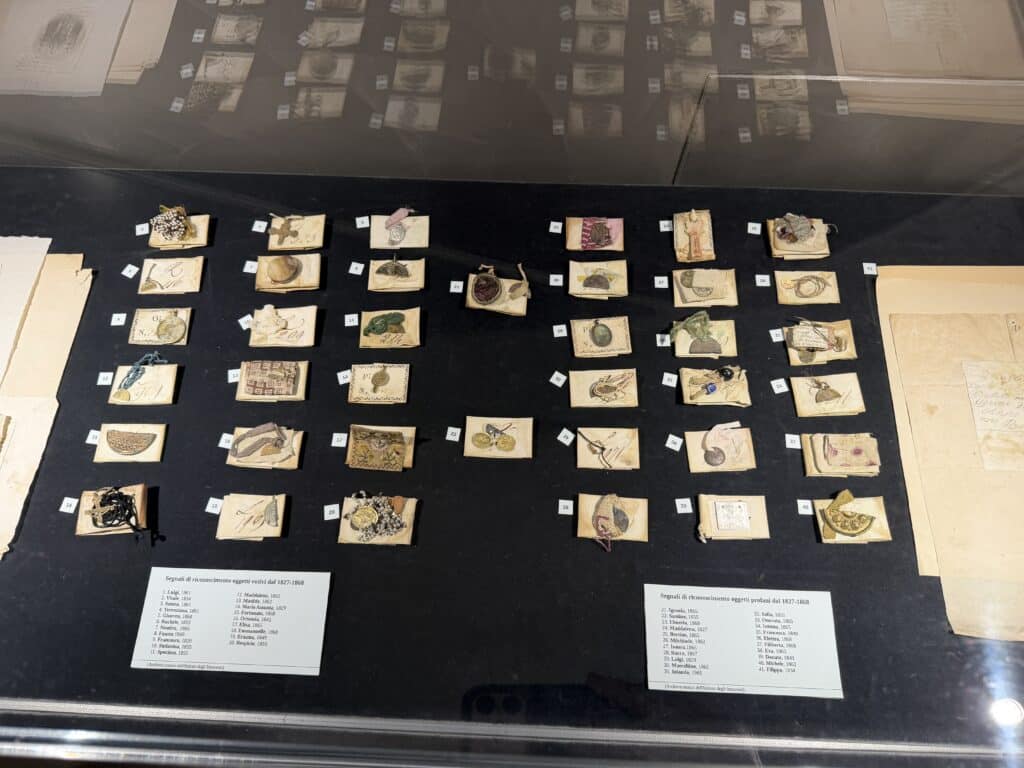


The Ospedale kept excellent records. Not only did they carefully save and record tokens that were left with the foundling babies in the event the parents did return to claim their child, but they also kept baptism registers, death registers, and information about the wet nurses and the babies they cared for. Combining all of these resources together, each child’s history can be reconstructed. These files were called “Polizze di Bambini” and were kept in “Filze”, which were held together with string. Below is a picture of what that looked like in practice, as well as some examples of how a child’s history could be reconstructed from the combination of records available in the archives. Click on the pictures to view them larger.


If you would like to visit the Museo degli Innocenti the next time you are in Florence, I highly recommend it. We were in Florence in March and most areas were very crowded and busy. However, the museum was quiet and peaceful–we were the only ones there, having arrived at about 5 in the afternoon–so it’s a nice place to visit to get away from the crowds or even the weather, as it is all indoors. It would be perfect on a rainy day.
As of May 2026, they are open from 9:30am to 7pm each day. The museum is a short walk from the Duomo-just search your maps app for Piazza della Santissima Annunziata. It costs 9 euro to enter just the permanent historical archive museum or 18 euro if you want to also see their other collections. More information can be found on the Museo degli Innocenti website and you can buy tickets online through that site too. We purchased ours in person at the door. If you want to visit only the permanent historical archive area, make sure you tell that to the attendant, so you get the correct ticket and you are pointed in the right direction.
Also, if you would like to help the Museum preserve the items in their archives, especially the over 40,000 tokens in their collection, you can make a donation to the Innocenti Foundation. Note that if you translate that page to English, it is going to use the word “Signals” instead of tokens.

